


A few years ago, companies used CODEXIS, DATIFY and ONEPOST in two areas: working with legislation, and keeping records. Artificial intelligence is moving that role considerably.
How companies used our systems until now
The first area was legislation and CODEXIS. An HR officer, an accountant or someone responsible for quality and compliance looked up a regulation, tracked its amendments or checked how current law handles a particular situation. Most of the time these were one-off cases that came up the moment a problem arose. For many users, CODEXIS was not a tool of everyday work.
The second area was record keeping. ONEPOST handles data boxes, DATIFY keeps documents, information, deadlines and the agendas built on top of them. Both systems typically cover what the main ERP or accounting system does not. Most often they replace the operational records kept in Excel, the agendas a company needs but whose development into the ERP would not pay off.
What AI changed
The change did not arrive all at once. It came from two directions.
The first is the development of AI itself. From the early chats that answered questions, to agentic systems that work with documents, data and the individual steps of a whole procedure.
The second is the connection between our systems. CODEXIS, DATIFY and ONEPOST no longer stand side by side as three separate applications. Through the ONEPOST - datové schránky and Datify - digitální AI kancelář add-ons, CODEXIS AI Agent reaches the contents of both, and on top of that it sees folders on your disk, on SharePoint or on OneDrive. Information moves between the systems and the Agent can work with it further.
Only both together widen what our systems let you do in a company.
What an HR officer's work can look like today
Picture an HR officer in a company that keeps basic employee records in its ERP. Alongside it she keeps a number of other overviews in Excel: leave taken, occupational safety training, further education, personnel documents and deadlines.
Connecting CODEXIS AI, DATIFY and ONEPOST changes this way of working. Nobody retypes a leave request into a separate spreadsheet any more. DATIFY records it and an automation requests the approval right away. Documents delivered through a data box travel from ONEPOST into DATIFY, where the Agent files them into the right agenda and processes them further. Manual data entry drops considerably.
That is only the first half of the change.
The real change comes with the data
What the HR officer can do with the available data and documents matters far more.
A typical request sounds like this: have every important piece of information about one employee in one place. Yet it does not come from a single system. Part of it sits in DATIFY, part in contracts, training certificates, requests and other personnel documentation in folders on a computer. Once the Agent has access to them, it can join them up and build the output that was asked for.
The HR officer therefore does not deal with which folder or record a particular detail sits in, nor with how to put the overview together technically. It is enough to give the Agent the data and the document folders, and describe what is needed:
"Build a clear employee card that shows, from the available documents and recorded details, their employment documentation, training validity, leave taken and other important information."
She can specify not only what information she wants, but also the shape of the output: a table, an overview, a chart, an employee card or a management report. The Agent does the work with the data.
What it looks like in practice
A model tax case that a law firm keeps in DATIFY shows it well. The file holds 44 documents: the notice opening the tax audit, assessment notices, appeals, procedural filings, hearing records and the regional court judgment. Every record carries a case reference, a date, the stage of the proceedings, the document type, the sender, a note and an attachment.
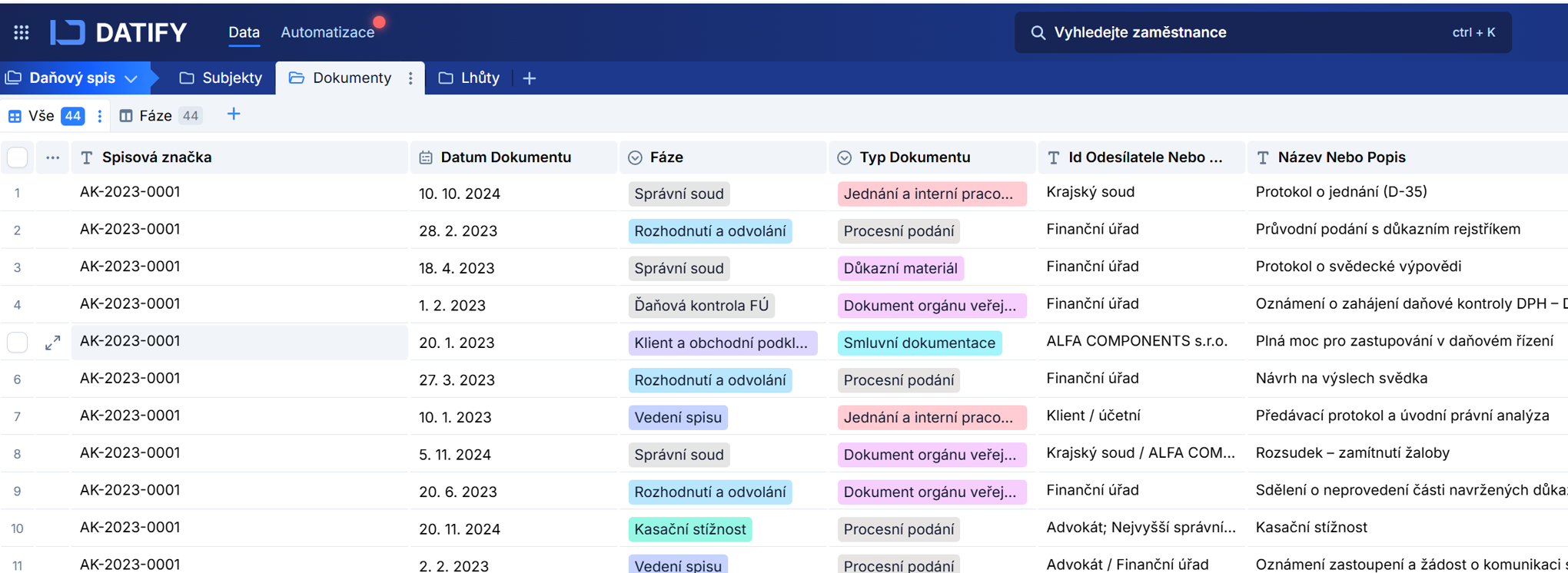
The records are complete and accurate. But they will not tell you where the case stands after three years. You have to sort the table, go through it stage by stage, look up the deadlines and add up the amounts.
Over the same data, the Agent prepares an overview that answers that question directly. It shows the last step and the nearest deadline, the number of documents and stages, the assessed tax and penalty, a timeline from the opening of the audit to the cassation complaint, and a list of deadlines marking which ones have a date and which do not. It also points out what the records are missing, namely the Supreme Administrative Court decision.
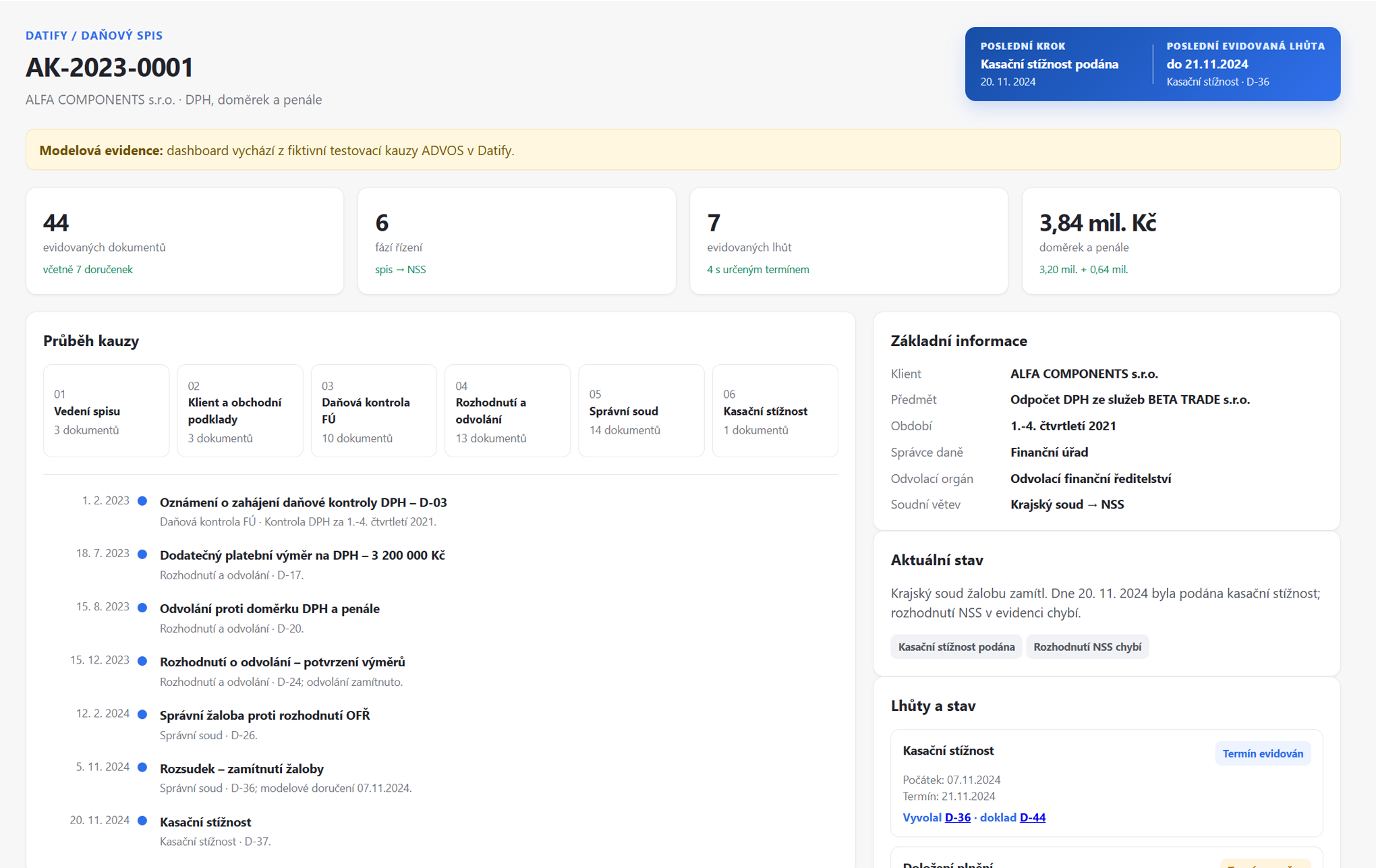
Nobody wrote a report, a formula or a pivot table. The data had been in DATIFY all along. What was missing was a way to get from it to an answer.
Excel as the universal middle step
Companies hold enormous amounts of data in their information systems. That very volume tends to make the work harder for an ordinary user.
The usual solution is therefore an export to Excel. The user downloads the data from the ERP, accounting, HR or another system, and only then filters it in Excel, joins it up, recalculates it and assembles tables, charts and reports. Excel becomes a layer between the information system and what the user actually needs. The reason is simple: the data exists in the system, only in a different shape, a different combination or a different view than the application offers.
This is where AI removes the most work. You do not have to think about how to export the data, which columns to join, what formula to write or how to build a pivot table. You describe what you want to find out and the form you want the result in:
"Compare how employee sick leave developed over the past three years by department and show the result as a table and a chart."
"Find the employees whose mandatory training expires within the next three months, split them by their managers and prepare an overview for each department."
What a user solves today by exporting to Excel and working by hand, an instruction to the Agent increasingly handles instead.
Companies are not short of data, they are short of a route to the answer
Modern ERP, accounting, manufacturing, HR and other systems produce enormous numbers of records. Alongside them sit contracts, internal rules, orders, minutes and personnel documents in various storage places. Users usually know very well what result they need. Until now they also had to know how to get to it technically: handle Excel, put a report together, go through documents by hand, or ask internal IT or a supplier for a new output.
Agentic AI turns this around. The user no longer describes the route, they describe the result. They give the Agent the sources, say what they want to find out and how it should look, and leave the work with the data and documents to it.
From records to active work with information
That is what moves the role of our products. ONEPOST is the entry point for documents and communication from data boxes. DATIFY holds the structured records above them, along with the related processes, deadlines and other company data. CODEXIS AI adds work with information and, with it, the legal and legislative context in which a company decides.
The result is no longer merely a record of information. What emerges is an environment where you search company data and documents, join them up, evaluate them, display them and turn them into a specific output according to what you need at the time. Without processing anything by hand, and without asking your software supplier for a new report.
The biggest change is not AI itself
The biggest change is that the distance is shrinking between what a user needs and what information technology can actually give them. Before, they worked the way a particular piece of software allowed. When they needed something else, they moved the data into Excel or started going through documents by hand and produced the output themselves. With AI it goes the other way: they describe what they want to find out from the available data and documents and how the output should look, and the Agent takes over the work with the information.
That is where we see the greatest opportunity in bringing CODEXIS AI, DATIFY and ONEPOST together. Not merely to record data, but to genuinely use it.